Showing posts with label Swami Vivekananda's Words. Show all posts

Wednesday, September 3, 2014

Swami Vivekananda Quotes in Hindi


Dear Readers,
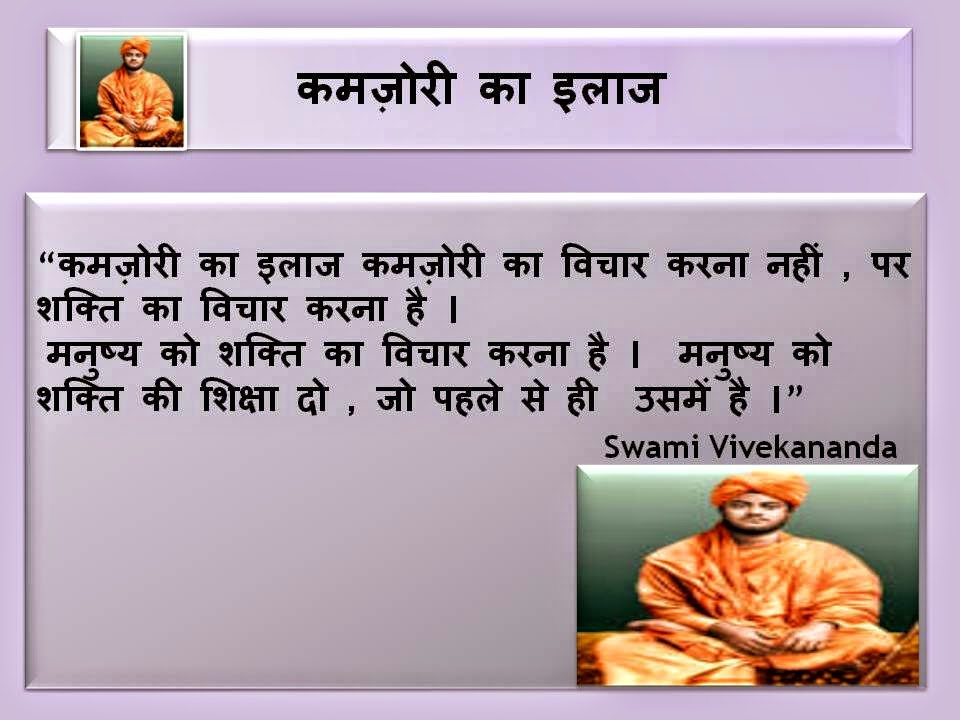
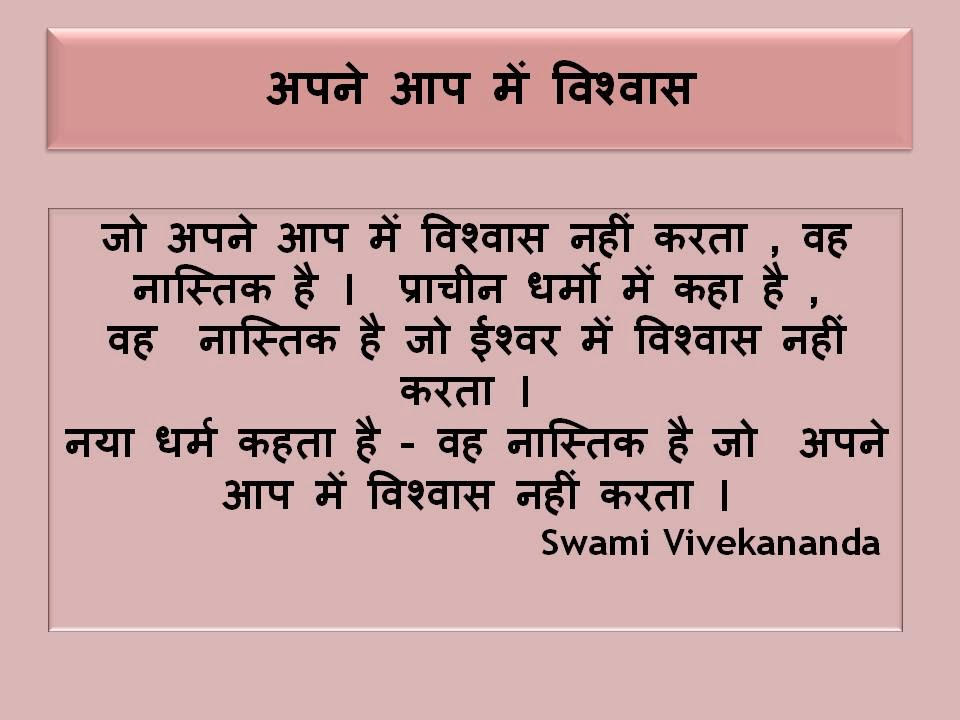
Enclosed below are some powerful quotes in Hindi by Swami Vivekananda. These Quotes are on the power of thoughts and how positive and righteous thinking helps build our mental strength and powers our achievements.

These Quotes are from the Ramakrishna Mission pocketbook of Quotes called "शक्तिदायी विचार ". This Book is available at Ramakrishna Mission Book stores.

Swami Vivekananda Quotes in Hindi:


To read other similar purposeful Quotations in Hindi please click the Links below:

***Note to Readers :
We all know that Swami Vivekananda was a much loved disciple of  Shri Ramakrishna Paramhansa. Did you also know that the Enlightened sage -Acharya Shriram Sharma was Ramakrishna Paramhansa in his former life ( Book reference : "My Life its Legacy and Message". This Book is  available in our Life Transforming Books section or in our online Books Library).

Source and Credits : 
The above Quotes are from the Ramakrishna Mission - pocketbooks (available in Hindi). To read Ramakrishna Mission Books online please visit our Life Transforming Books section and scroll down to the relevant sections . 
To order Ramakrishna Mission Books in Hindi online , please click the link enclosed.

                                                          ***

Wednesday, October 16, 2013

Swami Vivekananda achieved Mahasamadhi at age 39? The reason behind Swami Vivekananda's early passing.....

Enclosed here is a guest post by Spiritualbee.com explaining the reasons for the early passing and Mahasamadhi of Swami Vivekananda at age 39yrs. The reasoning for his early and voluntary passing away was provided by Swami Vivekananda himself, in his conversations with his Gurubhai Swami Abhedananda.

The reasoning for his early passing away is explained excellently using a descriptive and short video made by Spiritualbee.com. It makes for an excellent viewing and the guest post is enclosed here below......


GUEST POST by SPIRITUALBEE.COM:

"Swami Vivekananda, one of India’s greatest teachers of Vedanta Philosophy, left his physical body on July 4th, 1902. He was just 39 years of age.
Many people have wondered – what caused an evolved soul like Swami Vivekananda to die at such a young age? Aren’t yogi’s able to extend their own life-span and live for very long periods of time?
Actually, behind the passing of every realized soul such as Swami Vivekananda, there is an immense spiritual reality hidden, which we ordinarily do not grasp. Luckily for us, Swamiji (as he was called), himself revealed the truth in great detail. His amazing answer in the video below!
To read this full post and watch the video , follow the link below:

Wednesday, September 18, 2013

Swami Vivekanada Quotes in Hindi and English !

Swami Vivekanada Quotes on various subjects in both Hindi and English 

Death a certainty :


On imperfections and shortcomings of others:


Those that are ahead of their times:


Be strong, build inner strength - that is the essence of  all religions:


Educated people have a duty towards the weak in society:


The key to success :


In difficult times we can  rely only on our CHARACTER:


Love for all and One-ness of the soul- the basis of all his teachings:


The only definition of morality:


The definition of religion:


Power of Concentration:


Work is worship:


Do not fear failure:


Willpower:


The cure for weakness:


Believe in yourself:


The reason for sorrow and unhappiness:


How to achieve success:


For more Quotes in Hindi please the enclosed link  :

******

Source and credits : The last few quotes in Hindi are from the book - Shaktidaayi Vichaar, published by Ramakrishna Mission.
The source of quotes in the beginning is unknown.

Tuesday, February 5, 2013

Swami Vivekananda - A short video of his Life and Contributions.

Enclosed here is a short, informative and well done video on the "Life and Contributions" of Swami Vivekananda. 
The video focuses on educating us about  Swami Vivekananda's significant contributions   towards spreading the message  of Vedanta in the East and West. This video is a good watch for both adults and children.
(Vedanta = Eternal and uniformly applicable Truths for all mankind). 

Swami Vivekananda


Video Link :http://www.youtube.com/watch?v=Ebs-FZVmaeE
Source and credits : HSS (USA)


Other must read  articles and excerpts from  conversations with Swami Vivekananda:
1.Swami Vivekananda - on why people following DIFFERENT religions DISAGREE!
2.Swami Vivekananda and John D Rockefeller on  responsible use of personal wealth.
3.Vedanta and Swami Vivekananda on "eating meat' and using animals for scientific experiments/ animal testing.
4.How to be Spiritual - The Connection between Chastity and Spirituality

5.Swami Vivekananda's on: What is Yoga? Discovering we are not just Body but Soul

Note to readers : We invite you to visit our " Life Transforming Books" section to read many free books on Vedanta by Swami Vivekananda and the 16 direct disciples of Ramakrishna Paramhansa. These books are outstandingly written , very informative and written in a conversational style.

Links to the Gospel of Ramakrishna Paramhansa and The Complete Works of Swami Vivekananda are also available in our Life Transforming Books section.

A collection of 60 and more books in Hindi written  by the illustrious spiritual scientist and Master of the Vedas & Upanishads - Acharya Shriram Sharma are also available.

Thursday, January 17, 2013

Swami Vivekananda and his charismatic personality- in the words of a critic !

The below mentioned  letter is a quote from  " The Complete Works of Swami Vivekananda" and captures through a newspaper critics lens the personality and charismatic impact of Swami Vivekananda's personality and teachings  on a Western audience. 
The passage emphasises that the philosophy of the Vedas ( referred) to as "philosophy of the ancients" has deep relevance and significance for the modern man and present day "seekers of Knowledge'.
The sum and substance of the Vedas is that each soul is potentially divine, and that each soul has to rise above mere idolatry worship in the pursuit of self refinement and knowledge,  and that salvation can be achieved through the realisation of our responsibility towards nature and by being of service to  fellow mankind.That is by realising the "divinity" present in each of us.


A Brahmin of the Brahmins, Vivekananda gave up his rank to join the brotherhood of monks, where all pride of caste is voluntarily relinquished. And yet he bears the mark of race upon his person. His culture, his eloquence, and his fascinating personality have given us a new idea of Hindoo civilization.

He is an interesting figure, his fine, intelligent, mobile face in its setting of yellows, and his deep, musical voice prepossessing one at once in his favor. So it is not strange that he has been taken up by the literary clubs, has preached and lectured in churches, until the life of Buddha and the doctrines of his faith have grown familiar to us. 

He speaks without notes, presenting his facts and his conclusions with the greatest art, the most convincing sincerity; and rising at times to a rich, inspiring eloquence. 
As learned and cultivated, apparently, as the most accomplished Jesuit, he has also something Jesuitical in the character of his mind; but though the little sarcasms thrown into his discourses are as keen as a rapier, they are so delicate as to be lost on many of his hearers. Nevertheless his courtesy is unfailing, for these thrusts are never pointed so directly at our customs as to be rude. 
At present he contents himself with enlightening us in regard to his religion and the words of its philosophers. He looks forward to the time when we shall pass beyond idolatry — now necessary in his opinion to the ignorant classes — beyond worship, even, to a knowledge of the presence of God in nature, of the divinity and responsibility of man. "Work out your own salvation," he says with the dying Buddha; "I cannot help you. No man can help you. Help yourself."


Source and credits :
Visit our Life Transforming books section to read The Complete Works of Swami Vivekananda. The above mentioned excerpt is from Volume 3 , Frame 3 of the above mentioned compilation.

Tuesday, December 11, 2012

Quotes by Swami Vivekananda and Ramkrishna Paramhansa on: Education, God, How To Reform People?, Krishna and The Bhagvad Gita !

The following are exceptional lines/ quotes  from the lectures and writings of Swami Vivekananda. The quotes are on a range of subjects, covering  - The greatness of The Bhagvad Gita, Lord Buddha, The purpose of Education, Jesus and Krishna, Good and Evil. 


SWAMI  VIVEKANANDA ON EDUCATION:
"The less you read, the better. Read the Gita and other good works on Vedanta. That is all you need. The present system of education is all wrong. The mind is crammed with facts before it knows how to think. Control of the mind should be taught first. If I had my education to get over again and had any voice in the matter, I would learn to master my mind first, and then gather facts if I wanted them. It takes people a long time to learn things because they can't concentrate their minds at will."

SWAMI VIVEKANANDA ON THE PURPOSE OF EDUCATION:
"We want that education by which character is formed, strength of mind is increased, the intellect is expanded, and by which one can stand on one's own feet."

RAMKRISHNA PARAMHANSA ON MEN & GOD:
My Master used to say, "This world is a huge lunatic asylum where all men are mad, some after money, some after women, some after name or fame, and a few after God. I prefer to be mad after God. God is the philosophers' stone that turns us to gold in an instant; the form remains, but the nature is changed — the human form remains, but no more can we hurt or sin."

SWAMI VIVEKANANDA ON PROPHETS ACCROSS THE AGES:
Prophets preach, but the Incarnations like Jesus, Buddha, Ramakrishna, can give religion; one glance, one touch is enough. That is the power of the Holy Ghost, the "laying on of hands"; the power was actually transmitted to the disciples by the Master — the "chain of Guru-power". That, the real baptism, has been handed down for untold ages.

TAMAS, RAJAS and SATTVIKA:
The world is our fish basket, we must not depend upon it for enjoyment. Those who do are the Tâmasas or the bound. Then there are the Râjasas or the egotistical, who talk always about "I", "I". They do good work sometimes and may become spiritual. But the highest are the Sâttvikas, the introspective, those who live only in the Self. These three qualities, Tamas, Rajas, and Sattva (idleness, activity, and illumination), are in everyone, and different ones predominate at different times.

IS GOD A MERE MUNICIPAL AUTHORITY:
Today God is being abandoned by the world because He does not seem to be doing enough for the world. So they say, "Of what good is He?" Shall we look upon God as a mere municipal authority?

HOW TO REFORM:
Violent attempts at reform always end by retarding reform. Do not say, "You are bad"; say only, "You are good, but be better."

IS THERE ANYTHING CALLED 'RIGHTEOUS ANGER or JUSTIFIABLE KILLING?''
Priests are an evil in every country, because they denounce and criticise, pulling at one string to mend it until two or three others are out of place. Love never denounces, only ambition does that. There is no such thing as "righteous" anger or justifiable killing.

WOMEN- THE LION OR THE FOX?
If you do not allow one to become a lion, he will become a fox. Women are a power, only now it is more for evil because man oppresses woman; she is the fox, but when she is not longer oppressed, she will become the lion.

SPIRITUAL ASPIRATIONS BALANCED THROUGH INTELLECT:
Ordinarily speaking, spiritual aspiration ought to be balanced through the intellect; otherwise it may degenerate into mere sentimentality. . . .

KRISHNA AND THE GREATNESS OF THE BHAGVAD GITA:
All theists agree that behind the changeable there is an Unchangeable, though they vary in their conception of the Ultimate. Buddha denied this in toto. "There is no Brahman, no Atman, no soul," he said. As a character Buddha was the greatest the world has ever seen; next to him Christ. But the teachings of Krishna as taught by the Gita are the grandest the world has ever known. He who wrote that wonderful poem was one of those rare souls whose lives sent a wave of regeneration through the world. The human race will never again see such a brain as his who wrote the Gita.

GOOD and EVIL:
There is only one Power, whether manifesting as evil or good. God and the devil are the same river with the water flowing in opposite directions.

CREDITS and REFRENCES:
The above quotes are from the complete works of Swami Vivekananda: http://cwsv.belurmath.org/volume_7/vol_7_frame.htm

                                                                  ******


Thursday, November 15, 2012

How to be Spiritual - The Connection between Chastity, Spirituality and Incredible memory!

Illustrious sages, like those that are of the Paramhansas level, like Swami Vivekananda, Ramkrishna Paramhansa and Vedmurti Shriram Sharma Acharya have all left us a legacy of great literature that is simply invaluable. Their Lives are living examples of how to be Spiritual? Therefore it is pertinent to ask what defined their Spirituality? How did they live such exemplary lives and accomplish tasks of such extraordinary magnitude?


Each of them individually in their own lifetimes were voracious readers of great books. Those who lived in close proximity with Pt.Shriram Sharma Acharya know that he would read through multiple large texts in a short span of time and remember it all. 

Pt.Shriram Sharma Acharya wrote Literature greater than his own body weight. All his texts are scientific in content and research validated. How was this possible in a time when then internet was absent ? Similar was the prowess of Swami Vivekananda. He could read through volumes the size of Encyclopedia Britannica and remember it all !


In the words of these great sages themselves - sexual continence is a great enabler of energy, vitality and also of memory and concentration in people. Sexual continence helps retain and enhance the vital "Prana" or energy in the individual and that enables the accomplishment of a large body of work of extra ordinary magnitude !

The enclosed passage emphasising this point is captured in a conversation between Swami Vivekananda and his fellow disciple....


Quote of a  Conversation between Swamiji and a Disciple:
Swamiji: What do you say? Ask me anything you like from these ten volumes, and I will answer you all.

The disciple asked in wonder, "Have you read all these books?"

Swamiji: Why should I ask you to question me otherwise?
Being examined, Swamiji not only reproduced the sense, but at places the very language of the difficult topics selected from each volume. The disciple, astonished, put aside the books, saying, "This is not within human power!"

Swamiji: Do you see, simply by the observance of strict Brahmacharya (continence) all learning can be mastered in a very short time — one has an unfailing memory of what one hears or knows but once. It is owing to this want of continence that everything is on the brink of ruin in our country.

Disciple: Whatever you may say, sir, the manifestation of such superhuman power cannot be the result of mere Brahmacharya, something else there must be.

Swamiji did not say anything in reply."

The subject of Chastity occurs frequently in Swami Vivekananda's Lectures and Speeches. Enclosed below is a  seperate excerpt from a letter written in 1894 -once again emphasizing the connexion between chastity and spirituality. 

"I come back to the one, fundamental, vital point: 'Find God. Nothing else matters.' He emphasized morality as the basis of the spiritual life. Without truth, noninjury, continence, non-stealing, cleanliness, and austerity, he repeated, there could be no spirituality.

The subject of continence always stirred him deeply.Walking up and down the room, getting more and more excited, he would stop before someone as if there were no one else present. 'Don't you see,' he would say eagerly, 'there is a reason why chastity is insisted on in all monastic orders?

Spiritual giants are produced only where the vow of chastity is observed. Don't you see there must be a reason? There is a connexion between chastity and spirituality. The explanation is that through prayer and meditation the saints have transmuted the most vital force in the body into spiritual energy. In India this is well understood and yogis do it consciously. The force so transmuted is called Ojas, and it is stored up in the brain. It has been lifted from the lowest centre to the highest. "And I, if I be lifted up, will draw all men unto me."'

He would plead with the students as if to beg them to act upon this teaching as something most precious. Further, they could not be the disciples he required if they were not established in chastity. He demanded a conscious transmutation.'The man who has no temper has nothing to control."
                                                            ******
Source credits and references to the above article:


Thursday, November 8, 2012

Swami Vivekananda Quotes on : Worshipping The Mother Form, Upanishads, Buddhism, Vegetarianism, The difference between a Prophet and a Scientist !

Enclosed here are short excerpts from the words and writings  of Ramakrishna Paramhansa, and Swami Vivekananda. These  short excerpts are explanations on subjects as diverse as : How were the Upanishads written? Should we limit ourselves to the scriptural texts or go beyond? Why do we worship the Mother form or the female form of energy? When do societies move towards vegetarianism, what prompts them to make this move? What distinguishes a prophet from a scientist?The greatness of Buddhism!
The exact same thoughts and message on the same subjects is echoed in the extensive Literature penned by Pandit Shriram Sharma Acharya. 

Quoted text:

Ramakrishna Paramhansa on the short shortsightedness of placing a premium on wealth and social position: 
"Some people are proud of their wealth, their fame and social position,but these pride things are transitory. None can take them away with them after death.It is not good to be proud of wealth.You may say "I am wealthy",but then there are millionaires, multi-millionaires, and so on.
In the evening fireflies think that they are lighting the world; but when the stars begin to shine, their pride is subdued.The stars in turn think they are lighting the world,but when the moon shines the stars are put to shame. The moon too believes that her light illumines everything;but lo! the dawn appears and the rising sun effaces the light of the moon; If wealthy people thought of these things, the would no longer be proud of their wealth."
(Source and Credits :" The Gospel Of Ramakrishna" by Swami Abhedananda (a direct disciple of Ramakrishna Paramhansa).

Swami Vivekananda on the Limited Value of chanting Gods name without a corresponding internal change in the self:
There is a vast difference between saying "food, food" and eating it, between saying "water, water" and drinking it. So by merely repeating the words "God, God" we cannot hope to attain realisation. We must strive and practise.
(Source and Credits : http://cwsv.belurmath.org/volume_7/vol_7_frame.htm)

Swami Vivekananda on why many religions of the world worship the "Divine Mother" or the Female form of energy:
Mother is the first manifestation of power and is considered a higher idea than father. With the name of Mother comes the idea of Shakti, Divine Energy and Omnipotence, just as the baby believes its mother to be all-powerful, able to do anything. The Divine Mother is the Kundalini ("coiled up" power) sleeping in us; without worshipping Her we can never know ourselves. All-merciful, all-powerful, omnipresent are attributes of Divine Mother. She is the sum total of the energy in the universe. Every manifestation of power in the universe is "Mother". She is life, She is intelligence, She is Love. She is in the universe yet separate from it. She is a person and can be seen and known (as Shri Ramakrishna saw and knew Her). Established in the idea of Mother, we can do anything. She quickly answers prayer.
She can show; Herself to us in any form at any moment. Divine Mother can have form (Rupa) and name (Nâma) or name without form; and as we worship Her in these various aspects we can rise to pure Being, having neither form nor name.
The sum total of all the cells in an organism is one person; so each soul is like one cell and the sum of them is God, and beyond that is the Absolute. The sea calm is the Absolute; the same sea in waves is Divine Mother. She is time, space, and causation. God is Mother and has two natures, the conditioned and the unconditioned. As the former, She is God, nature, and soul (man). As the latter, She is unknown and unknowable. Out of the Unconditioned came the trinity — God, nature, and soul, the triangle of existence. This is the Vishishtâdvaitist idea.
A bit of Mother, a drop, was Krishna, another was Buddha, another was Christ. The worship of even one spark of Mother in our earthly mother leads to greatness. Worship Her if you want love and wisdom.
(Source and credits : http://cwsv.belurmath.org/volume_7/vol_7_frame.htm )

Swami Vivekananda explaining that as Societies progress( move away from military power to intellectual power, they move towards vegetarianism) 
The meat-eating animal, like the lion, gives one blow and subsides, but the patient bullock goes on all day, eating and sleeping as it walks. The "live Yankee" cannot compete with the rice-eating Chinese coolie. While military power dominates, meat-eating still prevails; but with the advance of science, fighting will grow less, and then the vegetarians will come in.
(Source and credits : http://cwsv.belurmath.org/volume_7/vol_7_frame.htm)


Swami Vivekananda explaining The Upanishads and how they were written ?( As algebraical symbols):
Vyasa's philosophy is par excellence that of the Upanishads. He wrote in Sutra form, that is, in brief algebraical symbols without nominative or verb. This caused so much ambiguity that out of the Sutras came dualism, mono-dualism, and monism or "roaring Vedanta"; and all the great commentators in these different schools were at times "conscious liars" in order to make the texts suit their philosophy.
The Upanishads contain very little history of the doings of any man, but nearly all other scriptures are largely personal histories. The Vedas deal almost entirely with philosophy. Religion without philosophy runs into superstition; philosophy without religion becomes dry atheism.
Vishishta-advaita is qualified Advaita (monism). Its expounder was Râmânuja. He says, "Out of the ocean of milk of the Vedas, Vyasa has churned this butter of philosophy, the better to help mankind." He says again, "All virtues and all qualities belong to Brahman, Lord of the universe. He is the greatest Purusha. Madhva is a through-going dualist or Dvaitist. He claims that even women might study the Vedas. He quotes chiefly from the Purânas. He says that Brahman means Vishnu, not Shiva at all, because there is no salvation except through Vishnu.
(Source and credits : http://cwsv.belurmath.org/volume_7/vol_7_frame.htm)


Swami Vivekananda on what distinguishes The Prophet from  The Scientist:
Knowledge can never be created, it can only be discovered; and every man who makes a great discovery is inspired. Only, when it is a spiritual truth he brings, we call him a prophet; and when it is on the physical plane, we call him a scientific man, and we attribute more importance to the former, although the source of all truth is one.
(Source and credits: http://cwsv.belurmath.org/volume_7/vol_7_frame.htm)


Swami Vivekananda on Vedanta Philosphy: How it asks you not to be limited by  whats written in the books. It prompts you to self experience and self realise.
"The ancient Hindus were wonderful scholars, veritable living encyclopaedias. They said, "Knowledge in books and money in other people's hands is like no knowledge and no money at all."
(Source and credits: http://cwsv.belurmath.org/volume_7/vol_7_frame.htm)


Swami Vivekananda on the greatness of Buddha and Buddhism:
Buddhism, one of the most philosophical religions in the world, spread all through the populace, the common people of India. What a wonderful culture there must have been among the Aryans twenty-five hundred years ago, to be able to grasp ideas!
Buddha was the only great Indian philosopher who would not recognise caste, and not one of his followers remains in India. All the other philosophers pandered more or less to social prejudices; no matter how high they soared, still a bit of the vulture remained in them. As my Master used to say, "The vulture soars high out of sight in the sky, but his eye is ever on a bit of carrion on the earth."
(Source and credits: http://cwsv.belurmath.org/volume_7/vol_7_frame.htm)
                                             ******


Friday, October 5, 2012

Vedanta and Swami Vivekananda on "eating meat' and using animals for scientific experiments/ animal testing.

In a lecture delivered  in 1896, Swami Vivekananda gives us his views on "eating meat" and whether meat eating is just and right? Swami Vivekananda clarifies that God views an amoeba and man as being of equal  significance to HIM. 

The central theme of Vedanta is " I am That" and "That I am " - meaning that our Individual soul and Consciousness is a subset of the Universal Supreme Consciousness. Therefore all beings are all part of One Supreme Soul. 

In the below mentioned excerpt Swami Vivekananda refers  to a segment of vigilantes in society that fights the use of Vivisection,(i.e. surgery on live animals for  scientific experiments/ or animal testing ) classifying  Vivisection  as "torture" and yet, at the same time justifying  the killing of animals as food. The justification being  that animals were made by God as "food" for human beings. 

Swami Vivekananda highlights the irrationality of this point of view and why so ?It s a wonderful excerpt that teaches us to be humane and kind to all in God's kingdom and even if we do make the choice of eating meat, we should not lay the making of that choice at God's door.


Quoted Text from Swami Vivekananda's lecture:

                                      PRACTICAL VEDANTA 

"For you must always remember that the one central ideal of Vedanta is this oneness. There are no two in anything, no two lives, nor even two different kinds of life for the two worlds. 

You will find the Vedas speaking of heavens and things like that at first; but later on, when they come to the highest ideals of their philosophy, they brush away all these things. There is but one life, one world, one existence. Everything is that One, the difference is in degree and not in kind. The difference between our lives is not in kind. The Vedanta entirely denies such ideas as that animals are separate from men, and that they were made and created by God to be used for our food.

Some people have been kind enough to start an anti vivisection society. I asked a member, "Why do you think, my friend, that it is quite lawful to kill animals for food, and not to kill one or two for scientific experiments?" He replied, "Vivisection is most horrible, but animals have been given to us for food." Oneness includes all animals. If man's life is immortal, so also is the animal's. The difference is only in degree and not in kind. 

The amoeba and I are the same, the difference is only in degree; and from the standpoint of the highest life, all these differences vanish. A man may see a great deal of difference between grass and a little tree, but if you mount very high, the grass and the biggest tree will appear much the same. So, from the standpoint of the highest ideal, the lowest animal and the highest man are the same. 

If you believe there is a God, the animals and the highest creatures must be the same. A God who is partial to his children called men, and cruel to his children called brute beasts, is worse than a demon. I would rather die a hundred times than worship such a God. My whole life would be a fight with such a God .But there is no difference, and those who say there is, are irresponsible, heartless people who do not know

Here is a case of the word practical used in a wrong sense. I myself may not be a very strict vegetarian, but I understand the ideal. When I eat meat I know it is wrong. Even if I am bound to eat it under certain circumstances, I know it is cruel. I must not drag my ideal down to the actual and apologise for my weak conduct in this way. The ideal is not to eat flesh, not to injure any being, for all animals are my brothers. If you can think of them as your brothers, you have made a little headway towards the brotherhood of all souls, not to speak of the brotherhood of man! That is child's play. 

You generally find that this is not very acceptable to many, because it teaches them to give up the actual, and go higher up to the ideal. But if you bring out a theory which is reconciled with their present conduct, they regard it as entirely practical."

Additional Excerpt on whether Swamiji ate meat himself? : "As regards food, when he was asked whether he was a vegetarian or a meat-eater, he said (i.e. Swami Vivekananda) that as a man belonging not the ordinary order of Sannyasins but to the order of the Paramahamsas, he had no option in the matter. The Paramahamsa, by the rules of that order, was bound to eat whatever was offered, and in cases where nothing could be offered he had to go without food. And a Paramahamsa was not precluded from accepting food from any human being irrespective of his religious beliefs. When he was asked whether he would accept food from non-Hindus, he told us that he had several times the necessity of accepting food from Mohammedans."

(G.S. Bhate describing the Swami's comments in Belguam - late 1892, http://www.vivekananda.net/Biographical/FoodsSVLiked.html)

Vedanta on : Why a Hindu is a Vegetarian ?
Swami Vivekananda lived and lectured for a short time. However his Gurubhai's and other direct disciples of Shi Ramakrishna Paramhansa continued to elaborate on the Swamiji's thoughts and the subject of Vedanta long after Swamiji passed away.

One such Gurubhai is " Swami Abhedananda" who was appointed by Swami Vivekananda during his lifetime as the head of the Ramakrishna Mission and Vedanta Centre, at New York and Boston. 

Swami Abhedananda is  a prolific writer and speaker and writes in an easy to understand style underlined by scientific explanations. His very popular booklet (20 pages) on "Why a Hindu is a vegetarian" , elaborates in detail on the Swami's above mentioned views on Vedanta and eating meat .

You can read this fantastic booklet by visiting our "Life Transforming Books" section or by clicking on the Book title mentioned in the above  paragraph.

                                            ****** 
References and credits to the above article:
http://www.ramakrishnavivekananda.info/vivekananda/volume_2/vol_2_frame.htm .
Lecture Part I (Delivered in London, 10th November 1896)
Swami Abhedananda on : Why a Hindu is a Vegetarian ? 
The concept of Vivisection:http://en.wikipedia.org/wiki/Vivisection


Wednesday, October 3, 2012

Ramakrishna Paramhansa, The Great Incarnation - a brief story of his Life !

The below mentioned excerpt details in brief the story of an orthodox Brahmin son called Shri Ramakrishna and how he became Ramakrishna Paramhansa:


MONDAY, July 1, 1895. (Shri Ramakrishna Deva)

Shri Ramakrishna was the son of a very orthodox Brahmin, who would refuse even a gift from any but a special caste of Brahmins; neither might he work, nor even be a priest in a temple, nor sell books, nor serve anyone. He could only have "what fell from the skies" (alms), and even then it must not come through a "fallen" Brahmin. Temples have no hold on the Hindu religion; if they were all destroyed, religion would not be affected a grain. A man must only build a house for "God and guests", to build for himself would be selfish; therefore he erects temples as dwelling places for God.

Owing to the extreme poverty of his family, Shri Ramakrishna was obliged to become in his boyhood a priest in a temple dedicated to the Divine Mother, also called Prakriti, or Kâli, represented by a female figure standing with feet on a male figure, indicating that until Maya lifts, we can know nothing. Brahman is neuter, unknown and unknowable, but to be objectified He covers Himself with a veil of Maya, becomes the Mother of the Universe, and so brings forth the creation. The prostrate figure (Shiva or God) has become Shava (dead or lifeless) by being covered by Maya. The Jnâni says, "I will uncover God by force" (Advaitism); but the dualist says, "I will uncover God by praying to Mother, begging Her to open the door to which She alone has the key."

Monday, October 1, 2012

Swami Vivekananda Quotes on: Religion, Hinduism, The Indian Nation, Bhagvad Gita, Religious Conversions and Ramakrishna Paramhansa

Enclosed here are Quotes that are  extracts and excerpts from the speeches and lectures of Swami Vivekananda. These quotes from Swami Vivekananda's works cover the subject of the Indian Nation and its principal characteristics, the subject of Hinduism, what is religion? The Quotes also tell us his thoughts on the subject and issue of religious conversion of the poor , the art of giving, and finally end with a comment on HIS MASTER- Shri Ramakrishna Paramhansa and his message to the world.

Swami Vivekananda Quotes:

On India and Hinduism:
"I am proud to belong to a religion which has taught the world both tolerance and universal acceptance. We believe not only in universal toleration, but we accept all religions as true. 

I am proud to belong to a nation which has sheltered the persecuted and the refugees of all religions and all nations of the earth. I am proud to tell you that we have gathered in our bosom the purest remnant of the Israelites, who came to Southern India and took refuge with us in the very year in which their holy temple was shattered to pieces by Roman tyranny. 

I am proud to belong to the religion which has sheltered and is still fostering the remnant of the grand Zoroastrian nation. I will quote to you, brethren, a few lines from a hymn which I remember to have repeated from my earliest boyhood, which is every day repeated by millions of human beings: 

As the different streams having their sources in different places all mingle their water in the sea, so, O Lord, the different paths which men take through different tendencies, various though they appear, crooked or straight, all lead to Thee.”
Why people from different religions DISAGREE:
That has been the difficulty all the while.I am a Hindu. I am sitting in my own little well and thinking that the whole world is my little well. The Christian sits in his little well and thinks the whole world is his well. The Mohammedan sits in his little well and thinks that is the whole world. I have to thank you of America for the great attempt you are making to break down the barriers of this little world of ours, and hope that, in the future, the Lord will help you to accomplish your purpose.


Swami Vivekananda and John D Rockefeller :The social responsibilities of corporations & utilisation of corporate wealth.

Enclosed here is a fabulous excerpt from the complete works of Ramakrishna and Swami Vivekananda. The excerpt highlights a conversation between John D Rockefeller and Swami Vivekananda on corporate social responsibility and the utilisation of corporate profits and corporate wealth. 
This excerpt is of great social relevance in today's times as more than ever before corporations and corporate profits drive social, economic, environmental policies of nations and the world.Never before has polarisation of wealth been more evident and endemic than it is today.
John D Rockefeller as we know was America's leading industrialist with a fortune that is yet unmatched if calculated as a percentage of the United States GDP. In those terms he ranks higher than Bill Gates and others. By the end of Rockefeller's career he himself along with the Rockefeller Foundation left a great legacy of charitable contributions. 


The following conversation between John D Rockefeller and Swami Vivekananda highlights that corporations are significant member servants of society. Corporations  earn their revenues from society and therefore carry with them a  social responsibility. 
The objective of corporations should therefore  not be greed and the ever increasing obsession of increasing share holder value at the cost of everything else. This point of " corporate greed for profits" is even more relevant today than it was in the early 1900's,  as today our society is even more skewed towards wealth being held by a corporate few as against everyone else.

Before we go to Swami Vivekananda's direct quote, let us also read an excerpt from R Gopalakrishnan's speech at I.I.M. Bangalore that also highlights this point of corporate social responsibility exceedingly well:


"It took another 15 years after this episode, that Rockefeller set up the Rockefeller Foundation in 1913, which has gone on to do an enormous amount of good work in society over the last several decades. The story illustrates the point of trusteeship. When you have earned a lot of money, whose money is it? Did that money come to you entirely because of yourself or is it possible that you are merely an instrument through which you should channelise it back to society? It is a very interesting question to ponder. I narrate this story, because the element of trusteeship comes out so clearly in the conversation between Swami Vivekananda and John D Rockefeller.


The ulterior motive of making the profit is not merely to declare a dividend or bonus shares. As JRD Tata said, what came from the people must go back to the people. Who does the company earn its profits from? It earns from the capital given by shareholders, from consumers, by trade with vendors, from using transport contractors and so on. If it has some surplus, who does that surplus belong to? Not just to the shareholders, it belongs to the whole community, the whole society.


In the global scenario, I suppose we could say what comes from the six and a half billion consumers of the world must in some way go back to the six and a half billion consumers of the world. The fundamental characteristic of working with the trusteeship concept concerns the real purpose of business -- to return to society what you earn from society. If you are going it to return it to society, you must work with a certain attitude described by Lord Leverhulme.

Lord Leverhulme was a founder of Unilever, the maker of Sunlight soap. We all are very familiar with the many brands of Unilever. He said that the task of a leader is to act with the humility of the mason who paves the roads. The man who paves the roads works with his toil and sweat; he knows that for decades after he has finished paving the road, millions of people will travel on those roads. They will travel with hope in their heart and ambition in their eyes, trying to seek out a fortune for themselves in whatever they are doing; but not once will they ever stop to think who it was that paved the road for them — that is the way it is for the mason, an anonymous servant of those travelers.

Being an anonymous servant of humanity is very much a part of a leader’s privilege; it is not his plight.

When that idea seizes leaders, then I think the concept of trusteeship leaps out at you, it makes leadership look effulgent, and it makes leadership meaningful. All of us must lay our head on a pillow for the last time sometime in our lives. It makes you realise that what you leave behind can make a big difference to someone. It is not your name or fame.
I would hope in the course of time that it will increase people’s commitment that business can be humane and need not be an inhuman pursuit of greed."


Quoted Text :Swami Vivekananda and Mr John Rockefeller - A conversation!

FIRST MEETING WITH JOHN D. ROCKEFELLER :(An excerpt from Madame Verdier's journal quoted in the New Discoveries, Vol. 1, pp. 487-88.)[As told by Madame Emma Calvé‚ to Madame Drinette Verdier] 

Mr. X, in whose home Swamiji was staying in Chicago, was a partner or an associate in some business with John D. Rockefeller. Many times John D. heard his friends talking about this extraordinary and wonderful Hindu monk who was staying with them, and many times he had been invited to meet Swamiji but, for one reason or another, always refused. At that time Rockefeller was not yet at the peak of his fortune, but was already powerful and strong-willed, very difficult to handle and a hard man to advise. 

But one day, although he did not want to meet Swamiji, he was pushed to it by an impulse and went directly to the house of his friends, brushing aside the butler who opened the door and saying that he wanted to see the Hindu monk. 

The butler ushered him into the living room, and, not waiting to be announced, Rockefeller entered into Swamiji's adjoining study and was much surprised, I presume, to see Swamiji behind his writing table not even lifting his eyes to see who had entered. 

After a while, as with Calvé, Swamiji told Rockefeller much of his past that was not known to any but himself, and made him understand that the money he had already accumulated was not his, that he was only a channel and that his duty was to do good to the world — that God had given him all his wealth in order that he might have an opportunity to help and do good to people.

Rockefeller was annoyed that anyone dared to talk to him that way and tell him what to do. He left the room in irritation, not even saying goodbye. But about a week after, again without being announced, he entered Swamiji's study and, finding him the same as before, threw on his desk a paper which told of his plans to donate an enormous sum of money toward the financing of a public institution.

"Well, there you are", he said. "You must be satisfied now, and you can thank me for it." 

Swamiji didn't even lift his eyes, did not move. Then taking the paper, he quietly read it, saying: "It is for you to thank me". That was all. This was Rockefeller's first large donation to the public welfare.


                                              ******
Source and credits:
Visit our Life Transforming Book section to read the Complete works of Swami Vivekananda.